Many radical changes have been brought about through the essence of modern day culture. Time seems to partake as the catalyst in the frequent changes; even dated back to when the caste system prevailed and the 'elite' culture dominated the network. Back when the caste system commanded control there were only a handful of select few who had access to this limited privilege that included popular works of art, and music. Later in history, however, these unspoken rules were slowly dismantled and altered for a new generation to come. As the economy shifted to its current state today, it became a much more familiar practice for people once considered 'common' to be able to gain access to the main frameworks of prized art, music, literature and so forth. This process has progressed even further with the additional use and evolution of technology. With more availability came more access and connections (particularly those formed by or through technology) had started to form more quickly and preserve its way into society- known as 'democratization'..
However as more gained access, some had started to question the values put forth by the easy use of technology. If it was really impacting our society, the means of communication, and bringing about social change as a forefront, or was it slowly degrading our standards. The very ideals of communication and our sense of culture and values were put into question. Such groups formed and argued over whether technology would be helpful integration or the downfall of us all.
However the technological advances that may result from this outreach of cultural stimulus have allowed for a development in the field for communication purposes. As the 'audience' absorbs more content from the surrounding media factors the more likely people may be to submit to fueling the media's processes of agenda setting by aiding as a benefactor to the content to which they are exposed. As the selections are made, people will begin to process the new information handed to them and may extract the meaning set behind the message. "When communicators select symbols for their messages, they must keep in mind that each person has a different frame of reference and, as a result, certain symbols may mean different things to different people". (
Culture and Communication pg 8). As people have separate perceptions about what is shown to them different people may interpret something such as ideas about a change in concept of communication and its effect on people's opinions about mass media forces and how it might create a transition in today's culture regarding how technology is used and otherwise. Further inspection in mass culture today has led to may criticisms of newly made customs. Some critics argue that the new esteemed culture is not what people should be looking for, rather a one closer to the old concept of 'elite culture'. "Other critics of mass culture believed that it had transformed our culture into just another commodity to be bought and sold and that it was intellectually destructive because it provided escapism and served a narcotic function in society" (
Culture and Mass Communication Pg 32). As mentioned in the article - some are led to believe that the new ideals brought upon a switch in academics in relation to society are the opposite of helpful and are instead raising the belief in a structure built upon narcissism and arrogance. The digital revolution that most are so eager to chastise in favor of reforming society to new ways, has brought to attention just how far that assurance has gone. Although the process of democratization might be useful for the distribution of art it has also led to a breakup in economic standards."I made more money from the book I gave away than the book I had sold. And the lesson there for me is not that this is a good way to make money, but the lesson is; this changes everything the industry is dead" (Moby,
PressPausePlay). The prospect that the industry that sells art is dead, accompanies the fact that while new art is being made, there is no where to sell it but online. And that the uses of technology has brought down that part of culture through using democratization - art might be spreading and expanding, but it is taking away some other uses and it is providing a condition for which, as people interpret it do not have to take part of - they can instead escape through technology.

Through technological advances (MRI scans) scientists have found the capability of 'mirror neurons' - meaning that as one person feels something, another person may 'mirror' those emotions and can 'emphasize' with the emotions that, that person is feeling as though they are experiencing it themselves. This can be brought about by the need to belong - to fit in. A sense of self can be developed by the actualization of empathy and how it works - people can begin to recognize themselves and others. As humans learn to communicate with others - and by extension emphasize with others with the idea in mind that life is fragile, then life can flourish. "Empathy is what allows us to stretch our sensibility with another so that we can cohere in larger social units. to emphasize is to civilize, to civilize is to emphasize" (Jeremy Rifkin,
The empathic civilisation). As humans learn about empathy, they can begin to share with others - a sense of community. Empathy can spread and show how people can learn to feel for others as well as themselves and it is further more spread more by the use of technology. An up rise in how people constantly evaluate and review society and objects is through the idea of self reflection. People are more focused on themselves and how to change problems by 'looking on the inside' by using insight instead of focusing on the larger whole of the picture. People are used to the idea of deciding what to do with themselves by self evaluating. "We need to be more adventurous with who we emphasize with. I think we need to emphasize with those in power.We need to understand how those in power, think about the world, their lives, their ambitions, only then can we develop strategies for social, political and economic transformation" (Roman Krxnaric,
The power of outrospection). As the video suggests, the human race is still in the learning process about empathy - and by extending it can we develop ideas for transformation. As people learn to emphasize or sympathize with others they can cultivate how well society works and how if needed to change it. One focus of some is how to change the education system. As it still focuses on industrialization and the set up consists of a factory based mindset. With the recent studies on divergent thinking, more people (children) might have a larger expansion for thought process. "Divergent thinking is an essential capacity for creativity. It's the ability to see lots of possible answers to a question. Lots of possible ways of interpreting a question. To think laterally to not think in linear or convergent. To see multiple answers and not one" (Sir Ken Robinson,
Changing Paradigms). If the education system was reformed to fit in divergent thinking it could be a way of setting up a designed way for people to think critically. They could find other possible solutions to problems instead of just doing it the way they are taught. This could also have an impact on the empathy factor as people learn a new way of thinking, they could find new ways to reach out and find a way for change.
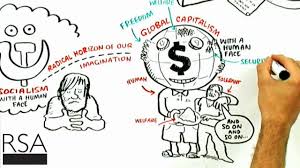
One repercussion of modern day society consumerism is the ways in which people go about buying the products. Nowadays it is not only just about what they are buying, but what comes along with it - a sense of gratification and purpose of fulfilling the consumerism act. by taking a part in cultural capitalism makes people feel like they are doing something to help. "My point is this very interesting short circuit where the act of egotist consumption and so on already includes the price for its opposite" (Slavoj Zizek,
First as tragedy, then as farce). As people continue to endorse the act of 'cultural capitalism' they believe in the idea that they are somehow helping to make a difference - which in turn inflates their own ego's for doing something good. This type of consumption results in how people may think more about marketing and content that is given to the customer and perhaps how it may connect to how marketing may effect what people may think of how it is distributed - including marketing technique such as ad placements on the Internet. Another further event brought to the public's attention is how through marketing and technology, the many ways it can be used, and what for. For example a documentary known as
Craigslist Joe helped question people's true values and ethics when one man; Joe Garner decided to see while America's economy crumbled, if he could live off of Craigslist and human kindness. He traveled across the country in hopes of sorting out the rumors of America's broken trust. What he found was that even though he was only a stranger to most, most people were willing to take the risk. "When I left my apartment in L.A I didn't know what to expect. I thought I might be sitting on a park bench stranded for a month. I've been blown away by the openness and generosity that people have shown me" (Joseph Garner,
Craigslist Joe). This experiment proved that while most people may be suspicious at first and resistant to help a stranger at first, they were willing to do so anyway. With the use of Craigslist it was shown that it was possible to connect with many people and complete strangers over the internet - and it was possible to find kindness even in the most unusual ways. As noted the internet and technology in general can effect and even help increase the use of empathy - all provide examples of a general connection. How people can even connect with others through technology, as it spreads news, media and the process of communication. "If we have gone from empathy in blood ties, to empathy in religious association ties to national identification, is it really a big stretch to imagine that new technology is allowing us to connect our empathy to the human race writ large in a single biosphere" (Jeremy Rifkin,
The empathic civilisation). As the human races ancestors learned to communicate and associate with others like them, the expansion of empathy began to grow. Aforementioned was how the development of technology can assist in ranging the human capacity for great emotional range and tolerance.

The widespread phenomenon of technological advances and communication skills has brought some advantageous qualities to the growing economic changes occurring within some societies and cultures. However it has also brought about a dissimulation of the proficiency of communication, the values of art and has broken the structure of the system of some businesses. Overall, while technology has helped spread the ever growing acceptance of a new range of art forms and has had a hand in dispersing and increasing empathy - as it spreads over the network, it still creates many problems as it creates solutions. It has made it more difficult for an artist looking for a sponsor to find one on account that the sponsor must shift through all other material out there. While everyone is creating art, it leaves almost no one left to appreciate what is left. Technology has left a hole where people can connect as well. As technology advances, and more and more spend time online, it leaves little time for actual face-to-face interactions. As the media is chosen for what is acceptable for the public eye - it adheres to what the viewer watches, which in most cases contains doses of violence or melancholy. All of these factors contribute to the case that while technology and media may enhance communication in some areas its overall aftereffect standing for a long period of time has the potential to do more damage than not.


