Most extensive variations of culture, art, communication, and expressions of visual literacy that are perceived in the media are commonly based misconceptions of a sort. Predictably people's misconceptions are widely influenced and cultivated by poor imitations of certain aspects of culture and art. The more that people are exposed to certain types of fallacy the more those preconceived notions are cemented. However there is cause for change - seen more often are more closely accurate versions of these misconstrued portrayals of people and art. As media advances and spreads people are starting to take notice of the once distorted interpretations. Technology also has helped with the spread of empathy by allowing more access for people to use, and by extension people have discovered more about the world and its misconceptions then they knew of beforehand. For years people have had prejudiced and biased claims towards one another - even to this day, but while it is still around the movement of culture, art, and the force of technology among other things have brought to light some varying perspectives of the distorted versions of people, technology, culture, communication, and visual literacy forms. In a new day and age people may still face biased views, but there are now more detailed explanations and analysis on the misconceptions of the essence of cultures. As people absorb new information they might form a bias on the topic introduced right away. And even as all styles and patterns of media influence them, it comes down to the human race on how they interpret the prevailed topic - despite the prestige that may force its way into their perceptions of the world.
Like the many ways that people might judge something like food, their firsthand perception of it might be about appearance before tasting it. Similarly people may judge another person by how they look or act before getting to know them. They may also believe snap judgments made by others about that person based on who they are. And like many preconceived notions - these judgments are usually first made by looking, In this way people place judgment on others without first knowing why. These prepossessed impressions may stick with people, but it is only more damaging when people know that they are being unfairly judgmental. it only blocks people's perceptions of the world more. "preconceived notions are locks on the doors to wisdom" - Mary Browne (Ceremony).
However overcoming preconceived notions can be overcome. Over the course of history people have started to become more welcoming, and more open about other people - while people may still be judgmental it is possible to fix. However as many warped and prejudiced values are placed an labeled on certain types of people it may possible to overcome - but it will be hard to change people's mind other years of thinking a certain way. It may be fixed in people's heads - as that might be the only view of others that they are able to see - especially seen trough the lens of media such as television, books, and otherwise of people misdirecting what another's culture may be. For example a longstanding stereotype that is commonly thought of the native tribes is that they are all alcoholics in nature. "I don't drink, never had a drop of alcohol in my life, not one drop". "What kind of Indian are you?" (Smoke Signals, Chris Eyre). These kind of biased judgments may be longstanding as some people are still inclined to believe them, but eventually over time - with the help of more accurate portrayals for native cultures and others, people may begin to eradicate those inclinations towards biased judgments. As culture and communication evolve over time it has become easier for change to happen. Social interaction has started to change, now that more people are willing to interact with others they once intolerant of. Society has grown and as it has grown - changes were made, from laws, government, schools and education systems to the construction of the human morale. "I propose a dynamic theory of social impact to account for how coherent structures of cultural elements emerge from the interactions of people located in space. in this conception, social structure is seen to result from individuals, differing in their ability to influence each other. in a dynamic interactive process of reciprocal and recursive influence" - Bibb Latane (Culture and Communication). As the structure of society changes and reforms so do people - they change along with it. People can learn, and can become more tolerant of other people more so then they were before. Social change through the embodiment of people's changing perceptions is possible.
As the past and future intertwine people are a participant in both - they have made the past, and can shape the future. The outcome is of their choosing. People may live in the shadow of the past, but they can change their future. Much like how in society people can change the outcome of something like an election. They have the power to either let the failure of the past haunt them, or to choose a brighter future. "We are products of our past, but we don't have to be prisoners of it" - Rick Warren (Smoke Signals). If people can perceive a better future from the past they had, it is possible to look ahead. The past can be left behind - not forgotten, but a lesson to be learned from. It can be studied and analyzed for mistakes but in doing so, a better understanding may make the path for a better future more evident. As people are constantly reminded of the past, they may experience a sense of discord, or detachment from the present world. This is also true of those of served in wars. They may experience P.T.S.(D). as a result of traumatic experience with the past. It may scar them, being reminded of a horrific tragedy that once occurred in their life, at random moments they can be thrown back into their past - or jolted back to a memory of trauma. "The sound of rain got louder, pounding on the leaves, splashing into the ruts; it splattered on his head, and the sound echoed inside his skull. It streamed down his face and neck like jungle flies with crawling feet" (Ceremony, Silko 11). So as people are constantly reminded of the past, and they may even revisit it, they are effected by it. The past is what connects people with the history of their story. They are by bound by the laws of time - and yet not consciously y. People may live in the present - but they can relive the past in their lives, as they mentally shift from one memory to the next. It is inconsistent where people may end up in their minds, but it will most likely derive from a piece of their past or future. A part of healing, to reach a better present or future may be to let go of the past - to recognize that it happened, but to also realize that there is nothing to be done as it has already done. For people to heal themselves of the past, they must remember but to also move on. "He gagged as he pushed the door open, and something gave way in hi belly. He vomited out everything he had drank with them, and when that was gone, he was still kneeling on the road beside the truck, holding his heaving belly, trying to vomit out everything - all the past, all his life" (Ceremony, Silko 156). When Tayo begins much of his healing process by 'vomiting out his past' and he begins to let go and accept the past - but he also chooses to move on. Similarly most people may try to get over their past by letting it go - to get everything out that was bothering them in the past - they will still have the memories, but they are also closer to having the future they envision for themselves.
Throughout the course of history, people have made mistakes, they have fought for a better understanding of how to change - for a chance at redemption. People may sometimes feel like they need that redemption for a previous fault, or misstep, even the idea of stepping into the past to undo what was done. that ideal may follow them, always at the forefront of their mind of what could have been done differently to fix the past. But even to the most unsuspecting people who foresee a chance to make a change - redemption is their ticket, maybe even a lifeline to a better life. One key is to remember the past, to remember the mistakes, to not forget, but to commemorate it, in seeking a new light. "Seeking to forget makes exile all the longer; the secret of redemption lies in remembrance" - Richard Von Weizsaecker (Seven Pounds). As people isolate themselves further from others, their lives may become a kind of exile for them - they are essentially stuck. But living on in the memory of the past can be as compensating as it is isolating. If people are willing to except the past - to remember, but to live on, redemption can be achieved. And another factor of change is empathy. People's reactions to others and their plight and in account considering their own. While empathy is a recognized concept ingrained into the human consciousness - it can be expressed in many forms. One of those many forms is art. Everyone and anyone can express themselves through one method or another. As art is a rapidly growing process by democratization - people are more assertive about showing their ideals for social change and redeeming the concept of the human consciousness through empathy (Press Pause Play). One such artist - Banksy using his art to express his views for social change. A art piece of his shows a protestor throwing flowers. This might be used to disclose the idea that while people want to fight more for a better society - they would rather do it peacefully and with empathy. Though many may want to achieve redemption, or to use the current technological advances to share ideas with others - people alone must interpret those ideas. They must determine how, and what they see will effect them, or their way of thinking. People are surrounded by influences from everywhere - so they must divvy up what content they want to intake. As mass media spreads more people are getting used to the process of a new form of communication. "As previously noted, mass communication consists of (1) professional communicators shaping and sharing messages, then (2) transmitting them over great distances using technological devices called mass media to (3) influence large audiences" (Culture and Communication 13). As technology advances and transmissions more - the process of spreading mass media and influencing the audience becomes more accessible than before. One path of redemption for people and even society - could be seen with the up rise of technology. As people use technology more and more often, people aspire to connect with others and to share what they know. People begin to spread empathy - as more people learn about news and other media feeds around the world from technology and other people, they begin to feel more empathy for others around them and may even be inspired to find solace in helping, and by extension find the key to redemption for themselves and a better society and change.
All of these methods - art, the change of people's minds towards other cultures and societies, media, technology are all connected and stem from the misconceptions that grip people. People's minds may take a while to convince, and false impressions of people may still be around, but with the help of others through the use of technology and the capacity of human empathy, social and cultural changes are made. People can be taught to remove ideas of misinterpretations and false images of cultures. In the beginning, judgments are made, and people are inclined towards the past, but it is seen that, that can change. As people are tied to the past and future decisions and memories they may look backwards or forwards for guidance, for redemption of mistakes made, but together people can create the change that they want. Misconceptions can be expunged with time - even now people can see change from when they saw mistakes from the past, they try to carve a path more towards tolerance, and other inventions come into play when focusing on awareness for world affairs. People have entered a new age where it is more accessible for them to gain information, and to use or compass it as they wish. Misconceptions may be viewed still, but change is a possible and visible for the future, and redemption is achievable for society to claim with empathy and people's willingness to dismantle those first placed misinterpretations.
Wednesday, May 21, 2014

Saturday, May 17, 2014
Seven Pounds
Life can embody the symbolism of growth, impulse, and the essence of the human spirit. In contrast death does as much, in an opposing form. As life's opposite in aspect, death takes instead of gives, it breaks down, renouncing drive or resolve, and in essence dismantles the character that humans have formed and developed. The two parallels coordinate in balance. One extension of that symbolism for life is water. It can be calm, or fashion into a raging influx of power. It can be beautiful and destructive all in the same sense. It personifies in many films the counterparts of light and dark, life and death. In some shots the blue of the water can be a calming relaxant, or a prospect of destruction. Similarly color can take up a fundamental component in cinematography. Complemented by the pieces of music composed for the film accompany the palate of colors elected for the scenes. These facets of cinematography are displayed in the film Seven Pounds. Ben Thomas (Tim) is constantly surrounded by these provisions placed in the setting. A constant frame seen in the film is the shadow of death that Ben carries with him. In most scenes the atmosphere, coupled with the music and color coalesces the integrity of his mission. Ben is constantly followed or shown with parallels of the accident, or another object that resembles something from his past. Haunted by the past, and a flicker of memory of the disaster that took (Sarah) his fiancee's life along with six others, Ben begins to plan his final act of restitution; he kills himself to save the lives of seven others - equal to the amount he killed in the accident. Throughout the film, there is a constant force of duality. The parallels between life and death are presented primarily in Ben and Emily throughout the film. Other elements displayed entirely in the film couple the main aspect projected to the audience in discrete moments. The many parallels of life and death shown between Emily and Ben appear in the diegesis, editing, mise-en-scene among other elements captured in the film, and through subtle hints shown between scenes.
At the beginning of the film Ben speaks of how God created the world in seven days, and how he destroyed is in seven seconds. His world collapsed when he sent a text and killed seven others. From that point on he lives a life full of abjection. His failure pursue's him in shadow, appearing in moments of weakness, vulnerability, and deficiency. The pain of his mistake follows in these moments, and he reassures himself that the plan he has conceived to pay penance for the causalities he caused will constitute a kind of reconciliation for the lives he took. On the opposite side of the spectrum Emily who suffers a heart condition and has a rare blood type. While Ben tows along a shadow of bereavement and dissolution, Emily in comparison is full of life and spirit. "Its very simple on this picture though anything that had to do with Ben was about taking things away from the frame, making it empty, making him alone. Anything with Emily, was filling the frame up with wonderful life, and I think it was extremely appropriate" (Todd Black, Seven Pounds). As Ben's and Emily's lives start to intertwine more and more, the more moments appear to further connect parallels of their lives to each other. One such parallel between Emily and Ben are the colors that surround them. In the scene where they are in bed together the low-key lighting filters the light on the pillows - so it looks approximately the same color of Sarah's dress that she wore the accident occurred. The color scheme between the scene with Emily as it flips back to Ben's memory of his fiancee dying shows that as he becomes closer to her, he is also reminded of his ending. As he spends more time with Emily Ben is subconsciously reminded of the disaster that occurred before (Seven Pounds). One other parallel that connects Ben to his past, and the overall dark cast that is a harbinger to his death is the similarity shown in his death scene and his past. As he is dying Ben recalls his past, as the ultimatum for his decision to kill himself. The shower curtain falls, the box jellyfish stings him and the ice he placed in the tub starts to scatter, it begins to look similar to the glass that shattered from the car in the crash. (Seven pounds). The tub Ben dies in looks much like a coffin, while a later parallel shows Emily in her tub listening to her new heart to feel connected to him. In comparison the view of her in the tub, Emily looks angelic and the tub's lighting appears like a halo.
At the beginning of the film Ben speaks of how God created the world in seven days, and how he destroyed is in seven seconds. His world collapsed when he sent a text and killed seven others. From that point on he lives a life full of abjection. His failure pursue's him in shadow, appearing in moments of weakness, vulnerability, and deficiency. The pain of his mistake follows in these moments, and he reassures himself that the plan he has conceived to pay penance for the causalities he caused will constitute a kind of reconciliation for the lives he took. On the opposite side of the spectrum Emily who suffers a heart condition and has a rare blood type. While Ben tows along a shadow of bereavement and dissolution, Emily in comparison is full of life and spirit. "Its very simple on this picture though anything that had to do with Ben was about taking things away from the frame, making it empty, making him alone. Anything with Emily, was filling the frame up with wonderful life, and I think it was extremely appropriate" (Todd Black, Seven Pounds). As Ben's and Emily's lives start to intertwine more and more, the more moments appear to further connect parallels of their lives to each other. One such parallel between Emily and Ben are the colors that surround them. In the scene where they are in bed together the low-key lighting filters the light on the pillows - so it looks approximately the same color of Sarah's dress that she wore the accident occurred. The color scheme between the scene with Emily as it flips back to Ben's memory of his fiancee dying shows that as he becomes closer to her, he is also reminded of his ending. As he spends more time with Emily Ben is subconsciously reminded of the disaster that occurred before (Seven Pounds). One other parallel that connects Ben to his past, and the overall dark cast that is a harbinger to his death is the similarity shown in his death scene and his past. As he is dying Ben recalls his past, as the ultimatum for his decision to kill himself. The shower curtain falls, the box jellyfish stings him and the ice he placed in the tub starts to scatter, it begins to look similar to the glass that shattered from the car in the crash. (Seven pounds). The tub Ben dies in looks much like a coffin, while a later parallel shows Emily in her tub listening to her new heart to feel connected to him. In comparison the view of her in the tub, Emily looks angelic and the tub's lighting appears like a halo.
Wednesday, May 7, 2014
In a land of myth and a time of magic...
This picture exemplifies the idea of 'low key lighting'.
 As in the scene there is little light, except for the glow of the nearby fire. It highlights Peter's expression to show that things are not working out in his favor, as he had hoped. With his face mostly shadowed by the dark, it reveals that he is most likely plotting something sinister. The lighting also pinpoints on his posture - it shows that he is being watchful, or keen to keep a close eye on someone or something else. While he is observing the scene there is a look of determination to get what he wants.

 and terror - seen from the viewpoint of a 'matte shot'. Morgana's terror at the possibility of her and her dragon Aithusa being captured is pronounced from the angle it is shot at - as the camera focuses on Morgana, while the well she is stuck in envelops the shot. It shows the conditions of how she and her dragon are being kept prisoner - and how her terror manifests at the thought of losing to Arthur and her enemies.

 This frame is an example of 'off -screen space'. The two characters Mary Margaret (Snow White) and Emma appear to be looking off screen - towards something else - their postures suggest an oncoming enemy as they are readying their weapons. Mary Margaret (right) is looking at the unknown entity as a threat so she is shown leveling her bow in a cautionary manner. Emma (left) is shown looking concerned as she is deciding what to make of the new threat.


 As in the scene there is little light, except for the glow of the nearby fire. It highlights Peter's expression to show that things are not working out in his favor, as he had hoped. With his face mostly shadowed by the dark, it reveals that he is most likely plotting something sinister. The lighting also pinpoints on his posture - it shows that he is being watchful, or keen to keep a close eye on someone or something else. While he is observing the scene there is a look of determination to get what he wants.
This image shows the concept of 'Décor' . Regina's office is highly stylized and extravagant. It shows how as the mayor of Storybrooke she has wealth and power. As the image shows that Regina is in her home territory, it also displays the conic symbolism of the fairy tale 'Snow white and the seven dwarves' in placing the red apples - another symbol of Regina's power in the front part of the shot.
This scene visualizes Morgana's dream,
and terror - seen from the viewpoint of a 'matte shot'. Morgana's terror at the possibility of her and her dragon Aithusa being captured is pronounced from the angle it is shot at - as the camera focuses on Morgana, while the well she is stuck in envelops the shot. It shows the conditions of how she and her dragon are being kept prisoner - and how her terror manifests at the thought of losing to Arthur and her enemies.
This scene portrays the example of 'costume'. A large part of the Doctor's personality develops when he changes into a new form - and essentially changes all aspects of who he is, including personality. Each Doctor's costume is their signature 'style'. It can even extend to a part of their personality. While both are dressed in formal suits the 11th Doctor's (left) signature clothing article is the bow tie - as his character always mentions how 'cool they are'. The 10th Doctor (right) usually displays a long brown trench coat or brown / blue suit. This can personify his flippant personality. Both costumes almost never change - as it is one way to differentiate between characters and their 'time'.
This frame is an example of 'off -screen space'. The two characters Mary Margaret (Snow White) and Emma appear to be looking off screen - towards something else - their postures suggest an oncoming enemy as they are readying their weapons. Mary Margaret (right) is looking at the unknown entity as a threat so she is shown leveling her bow in a cautionary manner. Emma (left) is shown looking concerned as she is deciding what to make of the new threat.
The concept depicted in this shot is classified as 'shallow focus'. The image clearly is modeled to exaggerate Jim's features and his expression. Everything else surrounding Jim; the interior of the pool, the background colors, even Sherlock's gun - pointed at him is blurred out of the shot. It is a clear stance to show Moriarty in his essence of character. The shot focuses on him only and does so in a manner that the audience can get a further description of who Moriarty really is.
This depiction of Snow White and Prince Charming's wedding is an example of 'color'. The way that the colors are placed around the area of the chapel shows the mood of the scene - happy. To the white of Snow's wedding dress (a portrayal of new found innocence and joy) to the large variety of colorful characters in the background show that the moment on screen is an Jubilant one. Even the stained glass in the very back show a wide array of colors - to further develop the idea of celebration.
This image has the analogy of 'deep focus'. As Sherlock Holmes and John Watson arrive for their first case together they are accompanied by Lestrade (Scotland Yard). The image focuses mainly on Sherlock and Watson's deductive work, but still keeps notice of Lestrade observing their work from the background. This image keeps focus on all elements and figures in the room - the dead woman, Sherlock and Watson determining the murder case and the watchful eye of Lestrade in the back. All characters are caught and remain in focus for this shot to show the attitudes of the men and the character interaction between them.
The concept that is illustrated in this scene is 'framing'. As Jefferson (the mad hatter) is surrounded by piles and piles of hats - they create a frame around him. The image shows his work - the hats, and his slow descent into madness. The hats border him from every side - he is surrounded by his masterpieces, and failures. He is practically drowning in his craft, suffocating in it as he works. The hats suffice as an idea for him, hope and freedom. But at the same time is eclipsed by his failure. He is bound by the hats and as a result goes mad.
The representation of this image is known as 'exposure'. In this scene Merlin is found burying the sword Excalibur into the stone. The lighting, or exposure in the scene is cropped around Merlin. Bright light filters right where he is standing - to illuminate the likeness and power of both the sword and Merlin. While the background forest landscape is dark in contrast. The light shining on Merlin is an example of overexposure - as the light is filtered right around Merlin much like a resemblance of a halo.
Monday, May 5, 2014
Music Video Analysis #2
 Images in all forms (i.e videos, movies, t.v, photos etc) all show how humans are further connected to imagery and how exposure to certain types of images will affect a humans behavior or attitude pertaining to a specific topic or subject. As humans gain more exposure from photographs, magazines, film and technology - media, and t.v, people can develop of sense of understanding through viewing the imagery and can grasp the concept further by establishing a sensibility of predicting the content of the material. As people begin to learn to 'read' images they can start to get a sense of how to not only get a better understanding of context, human emotion, reaction, space, but given the layout they can project and discover new meaning to all facets to be learned from images. By observing these images people can demonstrate a higher perception of how the world is perceived through the eyes of many. To further establish the power of images a selection of videos was analyzed using set terms to describe in greater detail the ways that images can be used for determining the process of artistic value and characterization. Some examples are: Blink 182 - Adam's song, The script - if you could see me now, five for fighting - 100 years, Blink 182 - I miss you, Blockhead - the music scene, Eminem - Mockingbird. In the video Adams Song by Blink 182 the 'genre' would be narrative, the 'editing' would account for the way the photographs are poised on the back wall behind the band, and the 'diegesis' is hinted to be about isolation, or being alone. Other terms that may be included are the 'mise - en -scene' which could be the impression of loneliness. In the video If you could see me now by the Script some terms that accompanied the video could be described as such: the 'flashback' could be seen as when the band is on stage performing. While the 'shot' could be interpreted as when the band is on stage, and while looking for inspiration the people they are looking for, are absent. The 'diegesis' might be explained as the appreciation of life. The terms that are most relevant in 100 years performed by five for fighting are: the 'focus' which is seen many times throughout the duration of the video - when the camera spotlights the piano in the meadow and the person playing it (the person changes throughout the video from the artist through a series of ages, and other people. The 'editing' would be directed at the different transitions through age at the artist's different stages of life. The 'genre' would be named as a narrative as it goes through the man's life at different points in time. The 'auteur' would be the artist, or band 'five for fighting'. The terms presented in the video I miss you by Blink 182 are: 'diegesis' as the prospect of being haunted (by the death of a friend or a past lover etc). The 'focus' mainly targets certain objects - like the spiders in the video. The 'scene / sequence' could be the transition between the band and the other characters as it shows the appearance of many different women and how their presentation changes as the video goes on (darker colors change to lighter - editing). A 'shot' from the video could be when one of the characters (a woman) is peering into a mirror and it shows all of the reflections from past lovers - or other people. This shot may also account that mirrors usually are used to show the 'self' or self reflection. The music video The Music Scene by Blockhead, is a series of images in the arranged in the fashion of animation. The 'auteur' is Anthony Shepard - who put the animation together of a course of two years or so. The 'mise - en -scene' seen by the artwork of the animation might be portrayed when the people are created in image by the technology and are processing information, while later on they are bound by that same technology. It shows that people can be artificial, while nature might be superior as it does not rely on the usage of technology to thrive. A recognizable term used in Mockingbird by Eminem is the usage of 'flashback' when in the video it shows him watching home made videos, as he reflect on the past, and considers the future. All images can show the importance of value and content, as more people begin to analyze film and other forms it may become easier to understand the decisions made by the media, directors, etc. As people who produce film bring pieces of thought into the art they create, people can recognize the idea formed behind the decisions made to create the video, and the pieces of material that were chosen, and why. People can harness the ideas brought forth by the power of images, and may be able to actuate the creative tools used to build such imagery and in turn show change in how images are read and annotated and help others understand the value in images in film and otherwise.
Sunday, May 4, 2014
Music Video Analysis

 Analyzing art, namely a visual broadcast is usually taken to mean how one might go about 'reading' a series of images presented in a consecutive order. For example to 'read' a music video, someone who studies film, or other subjects in that area, first must understand the importance that visual images hold. A large part in how humans learn can be taken from visual aid. The constant reinforcement of viewing images can show how people may react to certain images, or context. As people view media - TV, music videos, movies etc, they can take away meaning that is there for them to portray in their own way, how they see it. Each individual can assess their own meaning from a single bit of material presented to them. As they derive the meaning of the message, they can better understand how influential images can be and how the images can make people think about the context of the material in a atypical way of thought process. Furthermore images can present to people the idea of almost any topic in any manner of speaking. The subject chosen for the context can develop from anything the artist designates, and is distributed for the audience to capture and rebound either the meaning meant by the artist, or more commonly can be dismantled for a new meaning understood by the public. To do so (to correctly ascertain a full meaning from a piece of film) there are terms meant to assist in capturing the basic moments displayed in the film. These terms are noted as: the auteur (the director), the diegesis (objects, events that are not explicitly mentioned in the film - hidden subtext), editing (the way that clips from the film are put together), the usage of flashback / flash-forward (a jump backwards for forwards in diegetic time, commonly associated with memories), the focus (the way that light rays, and camera angles are shown), genre (the type of video - usually either noted as narrative; in which the video tells a story, or stylistic; in which the video refers more to artistic style than a plot), the mise - en - scene (things that are 'put in the scene' like: setting, decor, costumes, and lighting), the story / plot (used with narrative genres where the audience can infer a plot from the video), the scene / sequence (usually refers to a narrative film with the same character, time and place - a piece off ongoing film linked together), and the shot (A single stream of images, uninterrupted by editing). However some terms are not present in all forms of film, but rather are hinted at in the description of material, or are not there at all. For example some music videos where most terms can be established are: (M83 - midnight city, Sail - awolnation, Ed Sheeran - drunk, Jonas brothers - year 3000, The Lumineers - stubborn love, Da funk - Daft Punk, The last to say - Atmosphere). In the music video "midnight city" the 'plot' is where some children escape from a facility and go out into the world to test their powers. the 'shot' can be seen towards the end when the light is behind the children - which could also serve as a 'mise - en - scene' for hope. In Sail by awolnation the 'editing' could be the use of lighting (when the main character is being chased), or the 'scene' could be the transition between rooms -while the main character is playing piano, then is outside. In The Lumineers video stubborn love, the 'flashback' could be when the girl remembers the last time she saw her father. The 'focus' in the video could be represented as the feather that keeps showing up - which might serve as a remnant of her memories. In the video Da funk by Daft Punk the video features a man with a dogs head, and follows him as he travels around late at night. The 'diegesis' could be that no matter who you are, or rather what you look like people may treat you differently or rudely - whether it be based on appearance or some other factor. For the Jonas brothers year 3000 the 'genre' would be alternative, or narrative as is follows the band members into the future in the video. In The last to say by Atmosphere the 'auteur' or director would be Issac Ravishankara. Or in some other cases the auteur may be the band - as the artist who put in some personal touch to the video. All of these terms are used to further understand the making of film and design, and are there to help put into words the power and description that images hold.
 Tuesday, April 29, 2014
Culture communication and Media study:
Many radical changes have been brought about through the essence of modern day culture. Time seems to partake as the catalyst in the frequent changes; even dated back to when the caste system prevailed and the 'elite' culture dominated the network. Back when the caste system commanded control there were only a handful of select few who had access to this limited privilege that included popular works of art, and music. Later in history, however, these unspoken rules were slowly dismantled and altered for a new generation to come. As the economy shifted to its current state today, it became a much more familiar practice for people once considered 'common' to be able to gain access to the main frameworks of prized art, music, literature and so forth. This process has progressed even further with the additional use and evolution of technology. With more availability came more access and connections (particularly those formed by or through technology) had started to form more quickly and preserve its way into society- known as 'democratization'.. However as more gained access, some had started to question the values put forth by the easy use of technology. If it was really impacting our society, the means of communication, and bringing about social change as a forefront, or was it slowly degrading our standards. The very ideals of communication and our sense of culture and values were put into question. Such groups formed and argued over whether technology would be helpful integration or the downfall of us all.
However the technological advances that may result from this outreach of cultural stimulus have allowed for a development in the field for communication purposes. As the 'audience' absorbs more content from the surrounding media factors the more likely people may be to submit to fueling the media's processes of agenda setting by aiding as a benefactor to the content to which they are exposed. As the selections are made, people will begin to process the new information handed to them and may extract the meaning set behind the message. "When communicators select symbols for their messages, they must keep in mind that each person has a different frame of reference and, as a result, certain symbols may mean different things to different people". (Culture and Communication pg 8). As people have separate perceptions about what is shown to them different people may interpret something such as ideas about a change in concept of communication and its effect on people's opinions about mass media forces and how it might create a transition in today's culture regarding how technology is used and otherwise. Further inspection in mass culture today has led to may criticisms of newly made customs. Some critics argue that the new esteemed culture is not what people should be looking for, rather a one closer to the old concept of 'elite culture'. "Other critics of mass culture believed that it had transformed our culture into just another commodity to be bought and sold and that it was intellectually destructive because it provided escapism and served a narcotic function in society" (Culture and Mass Communication Pg 32). As mentioned in the article - some are led to believe that the new ideals brought upon a switch in academics in relation to society are the opposite of helpful and are instead raising the belief in a structure built upon narcissism and arrogance. The digital revolution that most are so eager to chastise in favor of reforming society to new ways, has brought to attention just how far that assurance has gone. Although the process of democratization might be useful for the distribution of art it has also led to a breakup in economic standards."I made more money from the book I gave away than the book I had sold. And the lesson there for me is not that this is a good way to make money, but the lesson is; this changes everything the industry is dead" (Moby, PressPausePlay). The prospect that the industry that sells art is dead, accompanies the fact that while new art is being made, there is no where to sell it but online. And that the uses of technology has brought down that part of culture through using democratization - art might be spreading and expanding, but it is taking away some other uses and it is providing a condition for which, as people interpret it do not have to take part of - they can instead escape through technology.
 Through technological advances (MRI scans) scientists have found the capability of 'mirror neurons' - meaning that as one person feels something, another person may 'mirror' those emotions and can 'emphasize' with the emotions that, that person is feeling as though they are experiencing it themselves. This can be brought about by the need to belong - to fit in. A sense of self can be developed by the actualization of empathy and how it works - people can begin to recognize themselves and others. As humans learn to communicate with others - and by extension emphasize with others with the idea in mind that life is fragile, then life can flourish. "Empathy is what allows us to stretch our sensibility with another so that we can cohere in larger social units. to emphasize is to civilize, to civilize is to emphasize" (Jeremy Rifkin, The empathic civilisation). As humans learn about empathy, they can begin to share with others - a sense of community. Empathy can spread and show how people can learn to feel for others as well as themselves and it is further more spread more by the use of technology. An up rise in how people constantly evaluate and review society and objects is through the idea of self reflection. People are more focused on themselves and how to change problems by 'looking on the inside' by using insight instead of focusing on the larger whole of the picture. People are used to the idea of deciding what to do with themselves by self evaluating. "We need to be more adventurous with who we emphasize with. I think we need to emphasize with those in power.We need to understand how those in power, think about the world, their lives, their ambitions, only then can we develop strategies for social, political and economic transformation" (Roman Krxnaric, The power of outrospection). As the video suggests, the human race is still in the learning process about empathy - and by extending it can we develop ideas for transformation. As people learn to emphasize or sympathize with others they can cultivate how well society works and how if needed to change it. One focus of some is how to change the education system. As it still focuses on industrialization and the set up consists of a factory based mindset. With the recent studies on divergent thinking, more people (children) might have a larger expansion for thought process. "Divergent thinking is an essential capacity for creativity. It's the ability to see lots of possible answers to a question. Lots of possible ways of interpreting a question. To think laterally to not think in linear or convergent. To see multiple answers and not one" (Sir Ken Robinson, Changing Paradigms). If the education system was reformed to fit in divergent thinking it could be a way of setting up a designed way for people to think critically. They could find other possible solutions to problems instead of just doing it the way they are taught. This could also have an impact on the empathy factor as people learn a new way of thinking, they could find new ways to reach out and find a way for change.
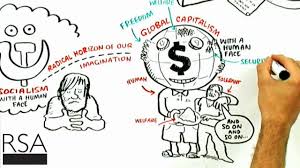 One repercussion of modern day society consumerism is the ways in which people go about buying the products. Nowadays it is not only just about what they are buying, but what comes along with it - a sense of gratification and purpose of fulfilling the consumerism act. by taking a part in cultural capitalism makes people feel like they are doing something to help. "My point is this very interesting short circuit where the act of egotist consumption and so on already includes the price for its opposite" (Slavoj Zizek, First as tragedy, then as farce). As people continue to endorse the act of 'cultural capitalism' they believe in the idea that they are somehow helping to make a difference - which in turn inflates their own ego's for doing something good. This type of consumption results in how people may think more about marketing and content that is given to the customer and perhaps how it may connect to how marketing may effect what people may think of how it is distributed - including marketing technique such as ad placements on the Internet. Another further event brought to the public's attention is how through marketing and technology, the many ways it can be used, and what for. For example a documentary known as Craigslist Joe helped question people's true values and ethics when one man; Joe Garner decided to see while America's economy crumbled, if he could live off of Craigslist and human kindness. He traveled across the country in hopes of sorting out the rumors of America's broken trust. What he found was that even though he was only a stranger to most, most people were willing to take the risk. "When I left my apartment in L.A I didn't know what to expect. I thought I might be sitting on a park bench stranded for a month. I've been blown away by the openness and generosity that people have shown me" (Joseph Garner, Craigslist Joe). This experiment proved that while most people may be suspicious at first and resistant to help a stranger at first, they were willing to do so anyway. With the use of Craigslist it was shown that it was possible to connect with many people and complete strangers over the internet - and it was possible to find kindness even in the most unusual ways. As noted the internet and technology in general can effect and even help increase the use of empathy - all provide examples of a general connection. How people can even connect with others through technology, as it spreads news, media and the process of communication. "If we have gone from empathy in blood ties, to empathy in religious association ties to national identification, is it really a big stretch to imagine that new technology is allowing us to connect our empathy to the human race writ large in a single biosphere" (Jeremy Rifkin, The empathic civilisation). As the human races ancestors learned to communicate and associate with others like them, the expansion of empathy began to grow. Aforementioned was how the development of technology can assist in ranging the human capacity for great emotional range and tolerance.
 The widespread phenomenon of technological advances and communication skills has brought some advantageous qualities to the growing economic changes occurring within some societies and cultures. However it has also brought about a dissimulation of the proficiency of communication, the values of art and has broken the structure of the system of some businesses. Overall, while technology has helped spread the ever growing acceptance of a new range of art forms and has had a hand in dispersing and increasing empathy - as it spreads over the network, it still creates many problems as it creates solutions. It has made it more difficult for an artist looking for a sponsor to find one on account that the sponsor must shift through all other material out there. While everyone is creating art, it leaves almost no one left to appreciate what is left. Technology has left a hole where people can connect as well. As technology advances, and more and more spend time online, it leaves little time for actual face-to-face interactions. As the media is chosen for what is acceptable for the public eye - it adheres to what the viewer watches, which in most cases contains doses of violence or melancholy. All of these factors contribute to the case that while technology and media may enhance communication in some areas its overall aftereffect standing for a long period of time has the potential to do more damage than not.
However the technological advances that may result from this outreach of cultural stimulus have allowed for a development in the field for communication purposes. As the 'audience' absorbs more content from the surrounding media factors the more likely people may be to submit to fueling the media's processes of agenda setting by aiding as a benefactor to the content to which they are exposed. As the selections are made, people will begin to process the new information handed to them and may extract the meaning set behind the message. "When communicators select symbols for their messages, they must keep in mind that each person has a different frame of reference and, as a result, certain symbols may mean different things to different people". (Culture and Communication pg 8). As people have separate perceptions about what is shown to them different people may interpret something such as ideas about a change in concept of communication and its effect on people's opinions about mass media forces and how it might create a transition in today's culture regarding how technology is used and otherwise. Further inspection in mass culture today has led to may criticisms of newly made customs. Some critics argue that the new esteemed culture is not what people should be looking for, rather a one closer to the old concept of 'elite culture'. "Other critics of mass culture believed that it had transformed our culture into just another commodity to be bought and sold and that it was intellectually destructive because it provided escapism and served a narcotic function in society" (Culture and Mass Communication Pg 32). As mentioned in the article - some are led to believe that the new ideals brought upon a switch in academics in relation to society are the opposite of helpful and are instead raising the belief in a structure built upon narcissism and arrogance. The digital revolution that most are so eager to chastise in favor of reforming society to new ways, has brought to attention just how far that assurance has gone. Although the process of democratization might be useful for the distribution of art it has also led to a breakup in economic standards."I made more money from the book I gave away than the book I had sold. And the lesson there for me is not that this is a good way to make money, but the lesson is; this changes everything the industry is dead" (Moby, PressPausePlay). The prospect that the industry that sells art is dead, accompanies the fact that while new art is being made, there is no where to sell it but online. And that the uses of technology has brought down that part of culture through using democratization - art might be spreading and expanding, but it is taking away some other uses and it is providing a condition for which, as people interpret it do not have to take part of - they can instead escape through technology.
Through technological advances (MRI scans) scientists have found the capability of 'mirror neurons' - meaning that as one person feels something, another person may 'mirror' those emotions and can 'emphasize' with the emotions that, that person is feeling as though they are experiencing it themselves. This can be brought about by the need to belong - to fit in. A sense of self can be developed by the actualization of empathy and how it works - people can begin to recognize themselves and others. As humans learn to communicate with others - and by extension emphasize with others with the idea in mind that life is fragile, then life can flourish. "Empathy is what allows us to stretch our sensibility with another so that we can cohere in larger social units. to emphasize is to civilize, to civilize is to emphasize" (Jeremy Rifkin, The empathic civilisation). As humans learn about empathy, they can begin to share with others - a sense of community. Empathy can spread and show how people can learn to feel for others as well as themselves and it is further more spread more by the use of technology. An up rise in how people constantly evaluate and review society and objects is through the idea of self reflection. People are more focused on themselves and how to change problems by 'looking on the inside' by using insight instead of focusing on the larger whole of the picture. People are used to the idea of deciding what to do with themselves by self evaluating. "We need to be more adventurous with who we emphasize with. I think we need to emphasize with those in power.We need to understand how those in power, think about the world, their lives, their ambitions, only then can we develop strategies for social, political and economic transformation" (Roman Krxnaric, The power of outrospection). As the video suggests, the human race is still in the learning process about empathy - and by extending it can we develop ideas for transformation. As people learn to emphasize or sympathize with others they can cultivate how well society works and how if needed to change it. One focus of some is how to change the education system. As it still focuses on industrialization and the set up consists of a factory based mindset. With the recent studies on divergent thinking, more people (children) might have a larger expansion for thought process. "Divergent thinking is an essential capacity for creativity. It's the ability to see lots of possible answers to a question. Lots of possible ways of interpreting a question. To think laterally to not think in linear or convergent. To see multiple answers and not one" (Sir Ken Robinson, Changing Paradigms). If the education system was reformed to fit in divergent thinking it could be a way of setting up a designed way for people to think critically. They could find other possible solutions to problems instead of just doing it the way they are taught. This could also have an impact on the empathy factor as people learn a new way of thinking, they could find new ways to reach out and find a way for change.
Subscribe to:
Comments (Atom)